


In order to meet Alaska’s educational challenges, we are addressing our public education system through five measurable goals:
Read DEED’s strategic plan, Meeting Alaska’s Education Challenge Together, to learn more about these measurable goals for improving Alaska’s system of public education.

The map below highlights school districts and organizations across the state who have adopted the Alaska’s Education Challenge three shared commitments through resolutions.
In September 2016, the State Board of Education and Early Development established five strategic priorities aimed at improving public education for all students in Alaska. Following the State Board’s initial actions, then-Governor Walker, in his 2017 State of the State address, spoke of the need to improve public education in Alaska. The Governor’s comments launched an effort to craft changes in our education system that will address student achievement gaps and increase graduation rates by making sure that every student across the state has equitable opportunity to learn and succeed.
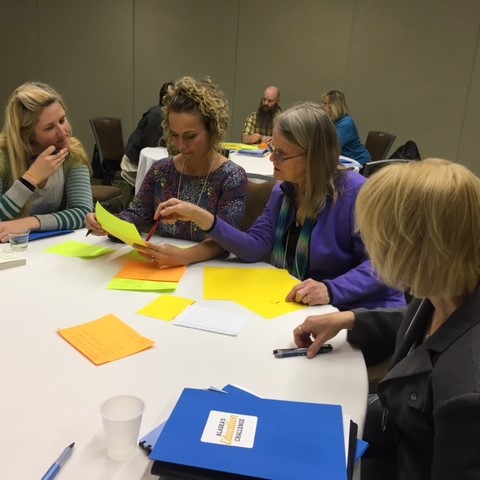
Following then-Governor Walker’s address, DEED released a public survey in February 2017 asking Alaskans to share their priorities for public education reform. Nearly 1,400 Alaskans in 109 communities submitted over 18,000 ideas for topics to be considered during the Alaska’s Education Challenge. From April to October 2017, DEED gathered nearly 100 Alaskans from all corners of the state representing diverse backgrounds, interests, and experiences to work collaboratively and focus their efforts on developing recommendations for each of the five strategic priorities set by the State Board. The State Board reviewed and accepted all 13 committee recommendations. Then-Governor Walker subsequently accepted the recommendations, and a report was submitted to the Alaska Legislature in January 2018.
In January 2018, the State Board, Commissioner Johnson, then-Governor Walker, then-Lt. Governor Mallott, commissioners, legislators, and representatives from the five committees and partner organizations held a press availability event and provided an overview of the work completed to date and shared next steps. Since then, DEED has continued working with partner organizations to focus its work on the five measurable goals that are most likely to improve student outcomes.
In January 2020, Governor Mike Dunleavy, in his State of the State address, highlighted teacher retention and recruitment and the importance of reading at grade level by the end of third grade – both priorities align with the Alaska’s Education Challenge measurable goals. He charged Commissioner Johnson with assembling a working group to review the root causes of teacher retention and recruitment issues in order to attract and retain great teachers. He also introduced the Alaska Reads Act during the 2020 Legislative Session – a bi-partisan approach to reading that reallocates resources with a focus on evidence-based solutions, including statewide teacher training, department-employed reading specialists, and the implementation of early literacy interventions.